Living the Past and Remembering the Future
(First Published by the National Gallery of Victoria’s (NGV) in their triennial publication)
TELL ME A STORY – A PROLOGUE
The child, wonder upon her brow, asks:
Tell me a story of a time when
the land still spoke freely to us,
of a time when we dwelt upon her.
Tell me a story of the time
when I knew all the creeks and rivers
that crossed upon her splendor,
of a time when the grass sang,
and the wind whispered in my ear.
Áhkku [grandmother] answers:
There is a line in the center back.
It is strong because it needs to be.
Carrying the gákti, the center line is where we start. It is where the gákti begins to take form;
shaping itself into the cloak of ancestors, carried on our backs, covering us in ancestral
wisdom and the safety of knowing,
“I am clothed in and by my ancestors”. [1]
A GENEOLOGY OF BECOMING.

Holding the yellow thread between my hands, I pull it taut. The colour illuminates the path that I lay down, yellow on red. Stitch by stitch, as the beautiful blend takes shape, a memory grows –not simply one of tangible certainties. Rather, the memory that inevitably reveals itself comes across in a harmony of possibilities as colours, meanings, and story slowly [re]forms. From this nexus of imagined creativities and enacted collectivities, the gákti beneath my hands comes into its own, taking shape, evolving into a landscape of memory that is both my own, but also distinctively other.
The gákti is a garment [ but also a landscape] entangled in and with cultural values, meanings, and concepts that has been collectively developed over a long period of time, and throughout many generations. Today it is often, perhaps even primarily seen as an important symbol of individual identity [2], an assumption easily explained if considered from a historical perspective: Though its predecessor, a simple tunic of leather and/or skin, is a garment common to the entire circumpolar area [3], in its later form the gákti took up a skape that visually distinguished it from surrounding cultures. [4] As such, the gákti has become unmistakable in its association with the Sámi people. To define the gákti as an ethnic marker alone, would nevertheless diminish its function because the gákti is also a multi-layered and dynamic creation of imaginations and ancestral knowledge.
For one, the gákti is a material manifestation of [a] Sámi world of existence – a silent, but visible survey of land [Eana], community [siida], and clan [sohka]. Through the cut and adornments, for instance, the gákti acts to situate its wearer in society, indicating both ‘place of belonging, family descent, gender, and relationship status’. [5] For one, the gákti is a legal document, testifying the wearer’s right to live in and on the clan-based territory of the siida. [6] Additionally, the gákti is a materialization of tiida, expressing the complexities of a more spiritual domain.[7] Indeed, the gákti provides a material site for the enactment of yellow and red, performing specific attributes that are deeply significant: red, for instance, is the colour of creation wherein Sáráhkka [8] reigns as queen, while yellow is the colour of Beaiváš [9], the Sun, she who ‘warms and nourishes the earth’. [10] Yellow and red are also the colours that in our muitalusat [stories] paint the Sámi genesis, a knowledge as old as our emergence.
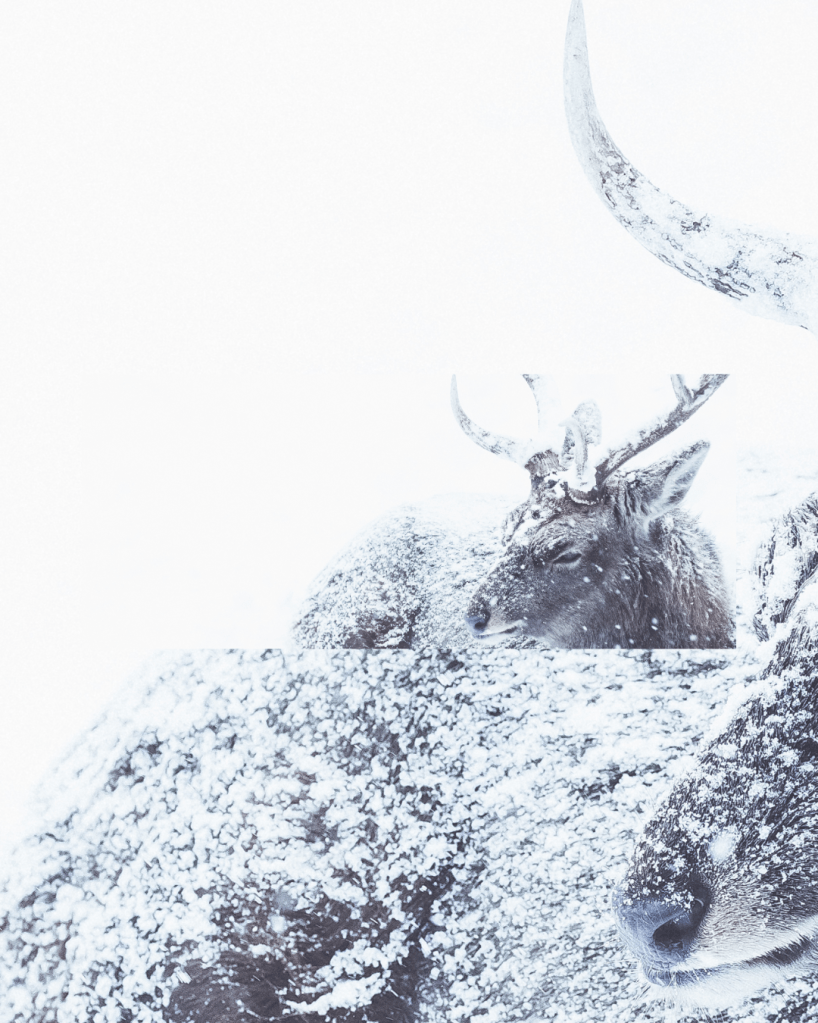
The muitalus of yellow and red is the first story, but perhaps it is also the last. It nevertheless tells of a beginning, even if it is not the only beginning. As I have heard it told, and as I tell it, the story of yellow and red narrates the sacrifice of Vaja, the sacred reindeer doe that gave up her life so that we might live. After all, nothing new can grow into being without the abdication of the old. In the story then, Vaja’s oblation does not erase her presence in the world. On the contrary, she transitions; her flesh and bones becoming the source from which the Creator imagined the living land into being. From the red depth of her blood, springs of rejuvenation was drawn forth to create the waterways; the lakes, the seas, the rivers, and the streams that still carries Vaja within because water is always confluent, merging the ‘memory of all substances that have dissolved within it’. [11]
From the amalgamation of land [flesh] and water [blood] a metamorphose happened, and the one who creates, Sivdnideaddji, took the two elements to make the soil. From here, They shaped our Máttaráhkuid, the Foremothers that are the first ‘landed’ beings, entities that both are of and emerge from the land. In the sky above, Beaiváš looked upon those that were newly formed. Arrayed in the splendour of Her yellow light, a deep and abiding love grew.

Like all the stars of the sky, the Sun contains every known element – water included, even if it takes on the shape of vapor and/or mist. And it is the Sun, after all, ‘which drives the water cycle’, circulating water between its many stages as liquid, mist, as well as solid state. [12] Traveling, first as mist, the water from the Sun eventually transposed into water. Beaiváš cried then. And when Her tears fell on the Foremothers that Vaja bore, the first landed ones birthed the Sámi people. In yellow we thus keep the memory of our conception and the knowledge of our covenant with the Sun, who is the giver of life. The red similarly carries a memory, albeit of Vaja, as well as the knowledge that she gave us the land, which thus gave us the ground we were later consecrated in.
And so, we are of the Sun and the Earth, of yellow and red, seeded by Beaiváš and nurtured by Vaja.
COLLECTIVE MEMORY
Establishing the progenitors of the Sámi people as female (or female presenting) creates an interesting, but also correct, understanding of the knowledge surrounding conception: Of old, the Sámi believes that every child begins as female. [13] Juhksáhkká, who is the goddess of the hunt as well as child birth, counts among her many responsibilities that of intervening when needed to change the child’s sex to that of male – even if she sometimes decides to leave the transition in between (and thus there is no gendered pronoun in our language). In the social structure of Sámi society, prior to colonization at least, the female focus in our genealogy is evidenced in old naming practices, which suggest that there was a relatively strong matrilinearity and matrilocality. [14]This is not an implication of Sápmi being a matriarchal society. On the contrary, Sápmi was (and in many communities continues to be) bi-lateral, recognizing women, men, and other gender identities as equal; their dynamics characterized by symmetrical and complementary domains without adding more or lesser value on account of which gender performed these roles and tasks. [15]

As to such roles and tasks, the relevance of females in our story of becoming is reflected in the fact that historically (as well as in present day) it is the women that hold the responsibility of gáktegoarrun [gákti-making] [16], suggesting that women ‘had an important role in maintaining and governing the judicial system of Sápmi’, including, but not limited to land tenure and asserting clan rights. [17] After all, even today it is an acknowledged truth that women ‘hálddašit bures sohkavuogádaga dieđuid’, or best manage and know the system of kin and clan. [18] My memories as they relate to gákti are as such primarily related to the women of my clan.

From my childhood, there is a memory of the gákti, and of yellow and red that resonates strongly still. My tjidtjie [mother] is dancing, moving between tables. There is colourful fabric gathered on the table to my right, pattern pieces pinned in place. To the left is tjidtjie’s worktable, a clutter of colours and objects in chaotic segments. To my eyes, it seems disorganized, but tjidtjie is, nevertheless, in complete control. From the speakers, the crackle of an old, but well-loved vinyl fuse with the husky tones of Leonard Cohen’s lyrics that state, ‘first we take Manhattan, then we take Berlin’. In her hands, she holds ribbons of yellow and red, and to my childish eyes it is almost as if she’s materializing an observance to the knowledge of our becoming. But then, as Sámi scholar, Gunvor Guttorm reminds us, to duddjot also ‘means using one’s hands to control techniques’ ritual functions’. [19] In this place (both in my memory and in this specific and localized moment in time), my tjidtjie thus becomes the keeper of a collective memory, and it is through her act of making the gákti, her gáktegoarruma, that she shares this memory with me, demonstrating ‘the ways objects themselves, as material forms, may signify through a specifically material semiotics’. [20]
No doubt anthropologists would extract this specific practice of memory-keeping, translating it into the vernacular of their discipline, by primarily focusing on how some objects hold the ability to recollect social relations and personal associations because they have transcended their utilitarian purpose. As anthropologist Anette Weiner, in her seminal book on inalienable objects state:
In societies with complex political hierarchies, precious possessions such as gold crowns, jewelry, feathered cloaks or fine silks may accumulate historical significance that make their economic and aesthetic values absolute and transcendent above all similar things. [21]
In their function as ‘mnemonic tools’, it is expected that certain objects evolve evolution into a material cultural expression that functions within deeply complex social and cultural relations, acting as a focus of collective memory, narratives, and constructions of both community and individual identities. [22] But to understand the gákti in this way would, to my understanding at least, be a disservice.
One of the more persuasive ideas relating to Indigenous ways of being (ontology), knowing (epistemology), and doing (axiology), is the idea that all dimensions of social life is intertwined. Consequently, there is a permeable quality to the boundaries between worlds, spheres, and times (pasts, presents, and futures) within Sámi philosophies and ontologies. Though this is an understanding that may, and do take on many forms, it is also reflected in the common understanding that both human and non-human entities have agency.
In our language[s], the latter two are distinguished as, luondu, or beings that do not speak (such as animals) and beings that do not breathe such as jávri, a lake, or Eana, the land. [23] But regardless of how we are named, we are all capable of subjective will. [24] How this philosophy transfers into materiality, changes the perception of objects. As Sámi dáiddar [artist] Outi Pieski explains, objects are ‘our ancestors’, living elders, with both a place and function within the system of kinship that makes up the world we alle live in [or besides]. [25] The understanding that objects are eallilan [elders] also have some serious ramifications on how a Sámi pedagogy develops.
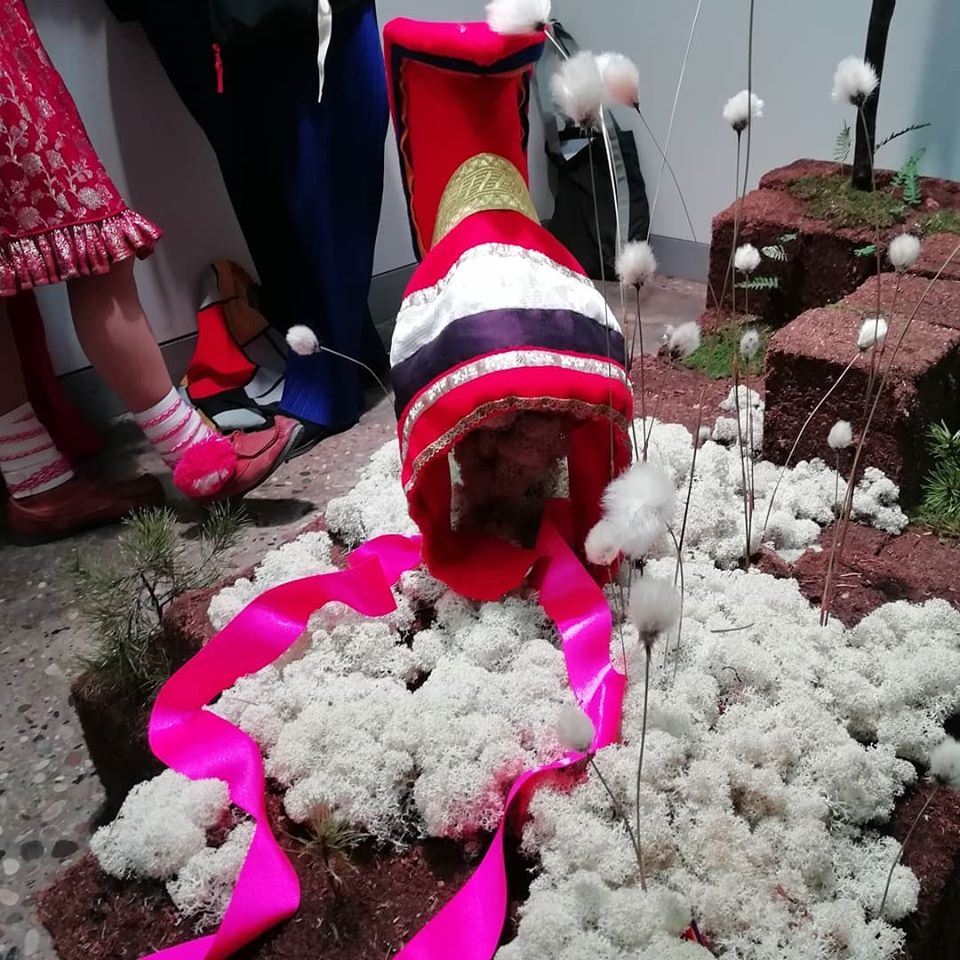
Typically, in the traditions of Sami childrearing, the younger learn from the elders; seeing, and then doing. [26] This is the way of árbediehtu [shared or inherited knowledge], which is a term conceptualizing knowledge as
the collective wisdom and skills of the Sámi people used to enhance their livelihood for centuries. It has been passed down from generation to generation both orally and through work and practical experience. Through this continuity, the concept of árbediehtu ties the past, present and future together. [27]
Amongst the many mechanisms that enact the story of yellow and red, árbediehtu is perhaps one of the more influential as it facilitates a sharing of knowledge through bodily practice (which we might term duddjot). Which is why, when years later I stepped into the role of storyteller, my chosen medium of deliverance was to duddjot. Just like my tjidtjie before me had done, I thus took up the needle to stitch the memory of yellow and red.
As I work the gákti with my hands [duddjot], creating a cloak of ancestral wisdom and shelter, I thus embed, but I also unearth because this is where I see and know the lives of my ancestors, and it is where my descendants will come to see and know me. ‘Mii lea generašuvnnaid mielde mannán, dego mun muittán hui bures’; ‘what the generations before has lived, I remember it well’. [28]
Still, it is important to recognize that ‘[s]hared narratives cannot be assumed, in and of themselves, to determine […] affiliations, as individual interpretations. Indeed, when individual interpretations happen, there is a possibility that ‘these narratives muddy the specific possibilities for the articulation of collectives’.[29] [But the memory of yellow and red is not simply re-asserted and narrativized by individuals who integrates their life experiences and/or perspectives into an evolving story of self. Quite opposite, yellow and red materialize as a collective memory because it is before, beyond, and after. There is no point of beginning or no point of end, meaning that it is a story that is the first, but perhaps it is also the last. The story of yellow and red, and the memory of the event proceeding such a narrative is as such always in motion and it continues to be re-lived whenever we make the gákti. The gákti then, is a shared site of meaning that provides the necessary foundation for us to re-remember. [30] In this way, the story of yellow and red becomes ‘the virtual presence of […] events […] and memory is the actualization of history in space as embodied movement’. [31] In that sense, it is not as simple as wearing the gákti that expresses the ancestral knowledge of our emergence. Rather, such knowledge lies in the making of the gákti.
Whenever I make a gákti then, I also practice a collective memory and in so doing, I enact a reality in which the memories of yellow and red are a specific and factual knowledge manifested in actions and creative practices. As has been articulated by Guttorm, ‘[m]uittán olles rupmašiin. Dan maid dál oainnán, gávnnan fas rumašlaš muittus’ – ‘I remember in my body. What I see, is preserved as a physical memory’. [32]This is how, throughout the many generations since our becoming, ‘[m]áttuid dieđut oidnojit ja leat vurkejuvvon dálá dujiin’, the knowledge of our ancestors has continued to appear and endure in (and also by) duodji. [33]
MEMORY AS LITERATURE.
A small note of explanation on the term duodji. Of old, duodji is a land-based:
practice of creation, involving aesthetics, knowledge[s] of materials, place and season, as well as a Sámi holistic worldview that touches upon spirituality, ethics and the interrelational qualities embedded in the multiple world[s] of creation. [34]
Consequently, the practice of duodji take part in a sophistocated system of knowledge that bases itself of a historical consiousness of aesthetics [vuogas], ancestral knowledge [árbediehtu], spirituality [vuoiŋŋalašvuohta], and the interdependence – or balance – of all things [birgejupmi]. Together, all these elemenths form both the philosophies and the ethics implicated in a Sámi way of life (which is the combination of our ways of being, knowing, and doing). This system is embedded in both the practice and the materializations – or objects – of said practice.

As a system of knowledge, duodji becomes a form of literature. Sadly, due to a specific and strategic process to devalue duodji as an epistemology [35], this is an understanding that often gets undercommunicated. This should come as no surprise because if we look to the Eurocentric confederation of imperial justifications and values (which all too often has been celebrated as the normative by which everything else must be judged), the conceptualization of literature centers itself in the written word. [36] From the latin term, littera, which means letter, the idea of literature has thus been allied with the act of writing. This has, in turn, created the common misconception that literature is books and other works of written words, which asserts a very specific hierarchy casting the written word as superior to the spoken word – or indeed, any other way of recordkeeping. [37] As Walter Benjamin explains in his seminal essay, the Storyteller; ‘[t]he earliest symptom of a process whose end is the decline of storytelling is the rise of’ the written word. [38] But how we write – or the perception of how the act of writing is performed – differs in both ontology and practice (or methodology).
In many Indigenous communities’ literature does exist, however, only it does so in sophisticated systems of multiplicities where literacy is a word shaded in the pluralities of many possibilities [39] – of which duodji is but one example. [40] In a Sámi context then, ‘njálmmálaš árbevierut leat meroštallon girjjálašvuohtan’, or ‘oral traditions should be thought of as literature’. [41] Still, a story is much more than a singular branch born from the tree of remembrance; it is joined by it’s siblings, who are muitit, to remember, and muitu, a memory. Derived from a common origin then, to tell a story is an act of remembrance, rooted in the connections and relations – the collectivety – within the siida where the story was first conceived of. In this sense, a muitalus should be considered a factual record, a ‘true-story’ that is opposite to the máinnas, the ‘made-up-story’ of fairy tales and other fictious stories. [42] The story of yellow and red, as a muitalus thus becomes the collective and performative muitu of our creation. [43] And as a collective muitu, the process of its enactment is a collective convergence of knowledge and material motion – no matter if it is individually performed. [44] Through this act, the making of the gákti also becomes a literary practice, which both imbue and disseminate our history as a people. Every gákti-maker thus transform into the keeper, but also the scribe of said history.
Keeping the ancestral knowledge from the beginning of our history in my body, I share with my female kin in a specific and Sámi literary tradition through a bodily practice that I pass one with every gákti that I make, or guide someone else to make. And so, I continue laying down stitches, sharing the memories and stories of yellow and red – remembering for those that have been, those that are, and those that have yet to come.
[1] This was first published as a poem in Galang 2.
[2] Astri Dankertsen, “‘Men du kan jo snakke frognersamisk’ : tradisjon og kulturell innovasjon blant samer i Oslo” (Oslo: A. Dankertsen, 2006); Elin Anita Sivertsen, “‘Jeg er same, og jeg bærer det med stolthet’: Identitet, ambivalens og tradisjon blant unge samer,” Kulturell kompleksitet i det nye Norge / Thomas Hylland Eriksen og Hans Erik Næss (red.) ([Oslo], 2011).
[3] Gudmund Hatt, Arktiske Skinddragter i Eurasien Og Amerika : En Etnografisk Studie (København: J.H. Schultz, 1914) pp. 60.
[4] Gjertrud Gjessing, Lappedrakten : En Skisse Av Dens Opphav, vol. 4:2, Instituttet for Sammenlignende Kulturforskning (Trykt Utg.) (Oslo, 1940)
pp. 47
[5] Liisa-Rávná Finbog, It Speaks to You : Making Kin of People, Duodji and Stories in Sámi Museums (New York: DIO Press, 2023), pp. 102.
[6] Finbog pp. 164
[7] e.g., Gunvor Guttorm, “Duoji Bálgát – En Studie i Duodji : Kunsthåndverk Som Visuell Erfaring Hos et Urfolk”(Tromsø, Det humanistiske fakultet, Institutt for kunsthistorie, Universitetet i Tromsø, 2001), pp. 59.
[8] One of the primary female deities of Sámi religion, Sáráhkka is the keeper of the fireplace [árran] and the mother of creation.
[9] Beaiváš is considered one of the primary deities of Sámi religion, and the entity is named in sources by various names and genders. This is on account of regional differences in how the Sámi would practice their religion.
[10] Anna Westman, “The Sun in Sámi Mythology,” Acta Borealia 14, no. 2 (January 1997): 31–58, pp. 36
[11] Joanne Barker, “Confluence: Water as an Analytic of Indigenous Feminisms,” American Indian Culture and Research Journal 43, no. 3 (January
1, 2019): 1–40, pp. 4
[12] Barker, pp. 22
[13] Today it is well establishe that every fetus start developing from the same starting point, which isthat all fetal genetalia are the same and that
they are phenotypically female
[14] Rauna Kuokkanen, “Myths and Realities of Sami Women: A Post-Colonial Feminist Analysis for the Decolonization and Transformation of Sami Society,” in Making Space for Indigenous Feminism (London: Fernwood Publishing, 2007), 72–92 pp. 74; Erik Toralf Solem, Lappiske rettsstudier (Oslo: Universitetsforlaget, 1970).
[15] Kuokkanen 2007
[16] Johannes Scheffer, The History of Lapland : Wherein Are Shewed the Original, Manners, Habits, Marriages, Conjurations, &c. of That People. (Oxford: At the Theater in Oxon, 1674).
[17] Finbog, It Speaks to You : Making Kin of People, Duodji and Stories in Sámi Museums, pp. 164
[18] Liv Inger Somby, “Mus Lea Ollu Muitalit, Muhto Dus Nu Unnán Áigi : Life-Stories Told by Elder Sámi Women – A Critical Social Analysis” (Sámi allaskuvla / Sámi University of Applied Sciences, 2016), pp. 27.
[19] Gunvor Guttorm, “Stories Created in Stitches,” Afterall: A Journal of Art, Context and Enquiry 45 (March 2018): 18–23, pp. 21
[20] Jaš Elsner, “Iconoclasm and the Preservation of Memory.,” in Monuments and Memory, Made and Unmade, ed. Robert S. Nelson and Margaret Olin (Chicago: The University of Chicago Press, 2003), 209 231 pp. 209.
[21] Annette B. Weiner, Inalienable Possessions: The Paradox of Keeping-While-Giving (Berkeley: University of California Press, 1992), pp. 37.
[22] Elizabeth Hallam and Jennifer Lorna Hockey, Death, Memory, and Material Culture, Materializing Culture (Oxford; New York: Berg, 2001)., p. 48-50
[23] 3 Mikkel Nils sara, “Land Usage and Siida Autonomy,” Arctic Review 2, no. 2 (October 31, 2011), pp. 148; Solveig Joks, Liv Østmo, and John Law, “Verbing ‘Meahcci’ : Living Sámi Lands,” The Sociological Review 68, no. 2 (March 2020): 305–21, pp. 308.
[24] Shawn Wilson, “What Is Indigenous Research Methodology?” Canadian Journal of Native Education 25, no. 2 (2001): 175 pp. 176; Jelena Porsanger, “Indigenous Sámi Religion : General Considerations about Relationship.,” in The Diversity of Sacred Lands, ed. Josep-Maria Mallarach,
Thymio Papayannis, and Rauno Väisänen, Europe (Gland: IUCN, 2012), 37–45 pp. 38.
[25] Outi Pieski, “Decolonizing the Museum and Public Art” (07.10.2020)
[26] Asta Balto, Samisk Barneoppdragelse i Endring (Oslo: Ad notam Gyldendal, 1997) pp. 92.
[27] 7Gunvor Guttorm and Jelena Porsanger, Working with Traditional Knowledge : Communities, Institutions, Information Systems, Law and Ethics : Writings from the Árbediehtu Pilot Project on Documentation and Protection of Sami Traditional Knowledge, vol. 1, Dieđut (Guovdageaidnu: Sámi allaskuvla, 2011) pp. 18.
[28] Biret Rávdna Eira, Sapmidrakten» bivttas lea suhttadan olusiid miehtá Sámi, (Govdageaidnu: Ođaspodda, 2021). Risten Lango kindly transcribed the interview, which I here cite from.
[29] Grant David Bollmer, “Virtuality in Systems of Memory: Toward an Ontology of Collective Memory, Ritual, and the Technological,” Memory Studies 4, no. 4 (October 2011): 450–64, pp. 452.
[30] Estelle Barrett, “Materiality, Language and the Production of Knowledge: Art, Subjectivity and Indigenous Ontology,” Cultural Studies Review 21, no. 2 (November 25, 2015), pp. 112.
[31] Bollmer, “Virtuality in Systems of Memory” 2011, 454.
[32] Gunvor Guttorm, “Lánjáid stellen : duddjoma ovdánahttinbargu fenomenologalaš geahčastagas,” Čállinmeattáhusaid guorran (Guovdageaidnu, 2013). pp. 337
[33] Gunvor Guttorm, “Duodji – Árbediehtu Ja Oapmi = Duodji – Hvem Eier Kunnskapen Og Verkene? = Duodji – Sámi Handcrafts – Who Owns the Knowledge and the Works?,” Duodji – Hvem Eier Kunnskapen Og Verkene?, 2007, s. 61-94., p. 62
[34] Finbog, It Speaks to You : Making Kin of People, Duodji and Stories in Sámi Museums pp. 15.
[35] Finbog 2023, pp. 258
[36] Pertti Anttonen, Cecilia af Forselles, and Kirsti Salmi-Niklander, “Introduction: Oral Tradition and Book Culture,” in Oral Tradition and Book Culture, ed. Pertti Anttonen, Cecilia af Forselles, and Kirsti Salmi-Niklander, Studia Fennica, Folkloristica 24 (Helsinki: Finnish Literature Society
(SKS), 2018), 7–18 pp. 8.
[37] Terry Eagleton, Literary Theory: An Introduction, Anniversary edition (Malden (Mass.): Blackwell, 2008) p. 9
[38] Walter Benjamin, “The Storyteller,” in The Novel: An Anthology of Criticism and Theory, 1900-2000, ed. Dorothy J. Hale (Malden, Mass: Blackwell Pub, 2006), 361–78., p. 364.
[39] Kristin Jernsletten, “The hidden children of Eve : Sámi poetics : guovtti ilmmi gaskkas” (Tromsø: University of Tromsø, 2011)., p. 3
[40] Guttorm, “Duoji Bálgát – En Studie i Duodji : Kunsthåndverk Som Visuell Erfaring Hos et Urfolk”, pp. 49; Pirjo Kristiina Virtanen and Irja Seurujärvi-Kari, “Introduction : Theorizing Indigenous Knowledge(s). In: Dutkansearvvi Dieđalaš Áigečála. 2019. Vol. 3, No. 2. Pp. 1-19., Dutkansearvvi Dieđalaš Áigečála. 3, no. 2 (2019): 1–19, pp. 2; Hanna Ellen Guttorm, Lea Kantonen, and Britt Kramvig, “Pluriversal Stories with Indigenous Wor(l)Ds Creating Paths to the Other Side of the Mountain.,” Dutkansearvvi Dieđalaš Áigečála 3, no. 2 (2019): 149–72, pp. 153.
[41] Hirvonen, Vuokko. 2009. “Juoiggus uksan sámi njálmmálaš girjjálašvuhtii : bálggis gillii, identitehtii ja iešárvui”. Sámi dieđalaš áigečála, 1-2, pp. 90-105., p. 96
[42] Gaski, Harald. 2019. “Indigenous Elders’ Perspective and Position. (Nordic Colonialisms and Scandinavian Studies) (Viewpoint essay).” Scandinavian Studies 91 (1-2), pp. 259 -268., p. 263.
[43] There are of course many variations of this story. I am simply sharing one of the many versions.
[44] Marita Sturken, “The Objects That Lived: The 9/11 Museum and Material Transformation,” Memory Studies 9, no. 1 (2016): 13–26; Jonathan Bach, “The Berlin Wall after the Berlin Wall: Site into Sight,” Memory Studies 9, no. 1 (January 2016): 48–62.
 Liisa-Rávná Finbog