MAKING KIN OF PEOPLE, DUODJI, AND STORIES IN SÁMI MUSEUMS.
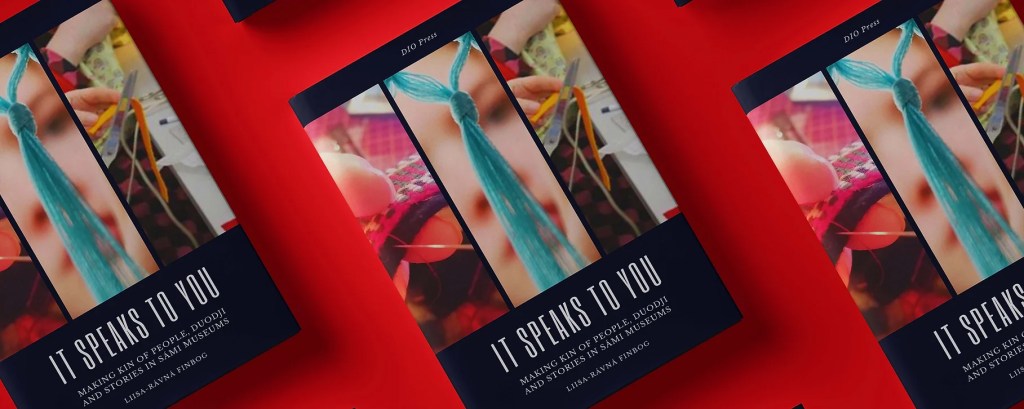
It seems so long ago that I was sent the first print proof from my editor at Dio Press, but it has really only been a year since.
At that point, I had worked on my manuscript for years and it honestly felt as if I had been running a marathon that never ended. Perhaps because Dio was my second publishing house.
Initially, I had approached a large and well-reputed publishing house in Europe, hoping that they would pick up my PhD dissertation and make it into a book. And for a while, the process was painless. I had a great editor and a good dialogue with the house. But then, my editor went into maternity leave and her successor was not at all as supportive.
In our first meeting, this new editor wanted to shift the focus of the book. Instead of it being a museological publication, my book was now supposed to be shifted into the anthropological department. After all, as they explained, a book on Indigenous cultures belongs with anthropology.
It didn’t matter that my work was focused on contemporary interactions between Sámi source communities and museums. It didn’t matter that my book was based on a dissertation that I had submitted for a degree in museology. It didn’t matter that I wanted it to be classified as museology.
A book on Indigenous peoples should always be classified as anthropology because anthropology is after all the study of the origin and development of human societies and cultures, and what is Indigenous peoples if not a racial category excluded from the history of the modern human. Indeed. ‘Lapps’, belongs in the ‘inferiority of […] races´, as one Scandinavian center for race biology determined in the early 20th century. [1]. The difference being a time lapse of about a century.
In a time where interest in eugenics where at an all-time high, combined with an imperialistic need to justify the stealing of lands, you can understand how Indigenous peoples where devalued as humans – even if it is impossible to excuse it. An editor in 2021, however, has no defense.
In my kindest moments, I am inclined to believe that my editor was simply blind to the structures of society; a society that has been built on the continuous creation of a hierarchy of lands, religions, and peoples. Chained by a colonial mindset that always places imperial Europe and whiteness at the top; unconscious and/or unaware of these chains and their own implications in them.
But as I tried to explain and argue the reasons for my book to be defined, not as anthropology (never that), but as the museological study that was its foundation, I stopped being able to feel that kindness. As I patiently outlined the issues of defining a book as anthropological simply because its source material is Indigenous in origin, me empathy with my editor disappeared.
In the end, I broke it off with both the editor and the publishing house.
To me, this was a heartbreaking moment. In all my years of academia, to be able to publish my work, and even more so, to be able to publish with this particular publishing house, had been a dream. But my dream had now become a nightmare, and I felt helpless in the face off it.
Luckily, what I shared this with friends and colleagues (of course having anonymized the editor and the publishing house), one person reached out to me with the possibility of publication. Jennifer Markides was the (and is) the series editor for ‘Community Wisdom‘, which is a primarily Indigenous-focused book series designed to push the boundaries of academic publication.
I first met Jennifer when I presented a paper in Winnipeg, at ‘Rising Up: A Graduate Student Conference in Indigenous Studies’; she was also the editor of the anthology that came out of said conference. Back then. we were acquaintances, brought together in both our indigeneity and academic work. As such, though I had already been disappointed once, I putt my trust in Jennifer and shared with her my manuscript. I don’t regret it.
Jennifer soon got back to me, and having read my work offered to have it published as part of the Community Wisdom-series. I accepted.
Instead of being just another anthropological study on Indigenous [insert whatever] at the very reputable and established publishing house (however racist some of their employees are], my book is a museological study published by a much younger, but also more innovative, publishing house that understands and celebrates Indigenous studies.

It Speaks to You…..
Based on a large pool of oral material as well as multiple Sámi museum collections, this book examines the connection between Sámi identities, duodji, sovereignty and Sámi heritage objects in museums.
Traditionally, duodji has been defined as Sámi “craft”, but in her work Finbog demonstrates how this definition is the result of a historical devaluation caused by multiple colonial strategies. She goes on to redefine the practice of duodji as an important Sámi epistemology of aesthetics and muitalusat [stories] centered within a system of relations that are expressed as bonds of kinship.
Drawing on the concepts, paradigms and analytical tools created from this system of knowledge, Finbog engages with multiple processes and expressions of Sámi Indigenous identity and sovereignty within the context of museums and cultural heritage institutions. Using the practices, materials, and relations of Sámi duodji as a lens, she thus provides new insights into the role of Sámi museums as Indigenous institutions, and furthermore how such institutions have come to provide an important component of Sámi epistemologies.
By way of multiple conversations as well as museum visits with duojárat, or practitioners of duodji, Finbog also investigates the relation between museums, duodji, and Sámi source communities, showing how the formation of these relations have a massive impact on both Sámi identities and perceptions of sovereignty. As such, the book provides a far more complex picture and understanding of museum collections, Sámi museums as cultural heritage institutions, and the multiple and diverse processes that are initiated in the negotiation of Sámi identities and expressions of sovereignty, than has been historically assumed.
The book is available for purchase at Dio Press as well as amazon and adlibris.
[1] Kjellman, Ulrika. 2013. «A Whiter Shade of Pale: Visuality and race in the work of the Swedish State Institute for Rae Biology».. Scandinavian Journal of History 38 [2], 182-201, pp. 190.
 Liisa-Rávná Finbog