John Savio, Rabindranath Tagore, and a Trans-Indigenous Anti-Colonial Modernism
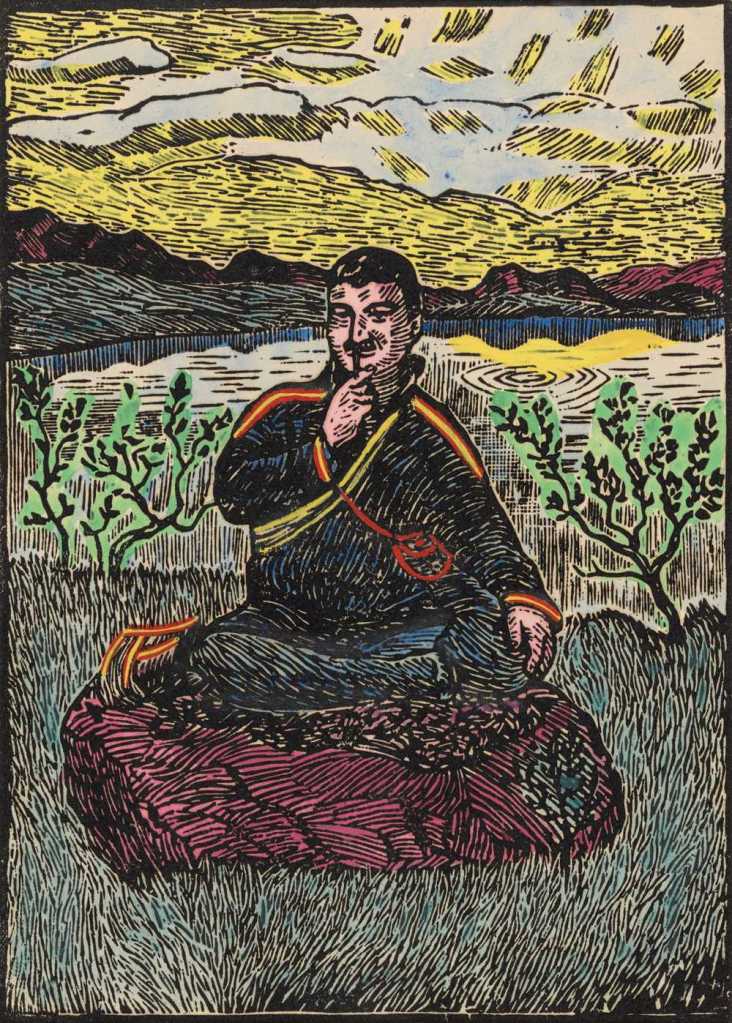
© John Savio, Summer, Year Unknown, Woodprint, 270 x 155 mm. Saviomuseet. Photo: Ove Kvavik, Munchmuseet
The Sámi artist John Savio (1902-1938) is, in my opinion (which is admittedly a well-researched one), a transformative figure in the history of Sámi visual culture and art, or what we might term dáidda. At a moment when colonial policies sought to marginalize Sámi languages, knowledge systems, and relationships to land, Savio developed a distinctive artistic practice that insisted upon Sámi presence and permanence. Largely self-taught, he moved between Sámi lifeworlds and the wider artistic debates of the early twentieth century, particularly those associated with modernism and its primitivist tendencies, producing works that continue to complicate how Indigenous art, modernity, and cultural resistance are understood today.
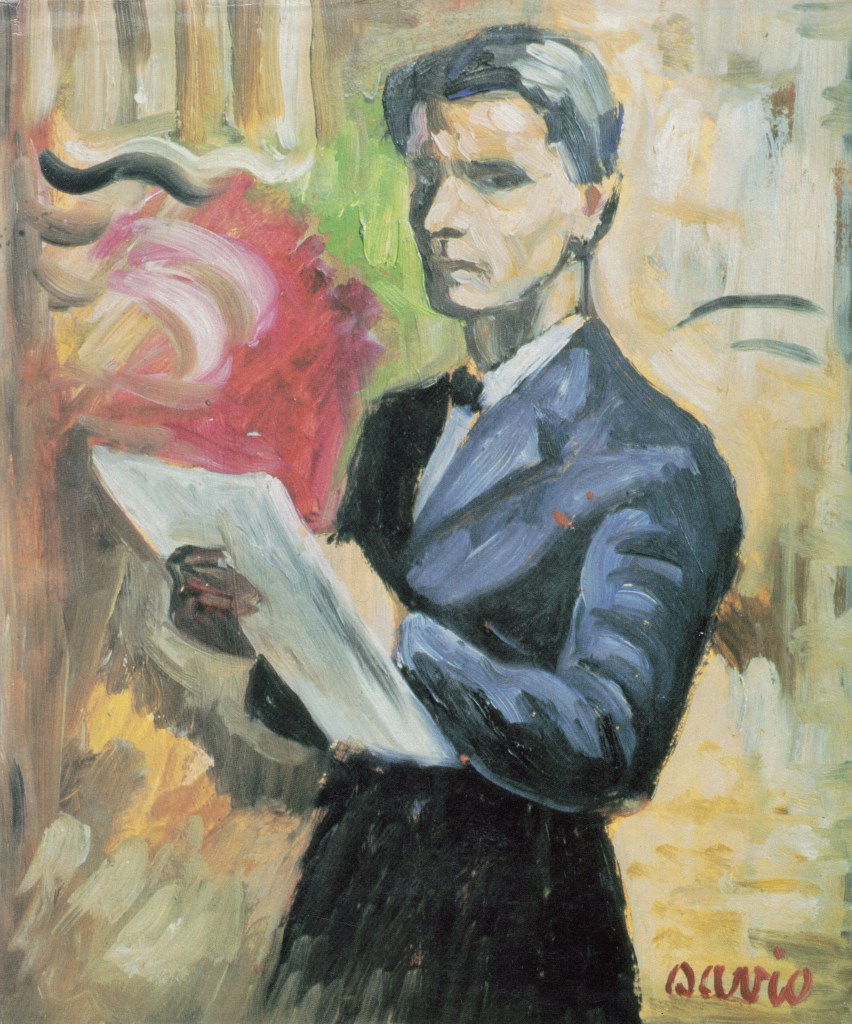
© John Savio, Self-portrait, Unknown Year. (From the book «John Andreas Savio : same og kunstner : en monografi» by Hans Nerhus, published in 1982 by Forlaget Form og Farge)
Yet who was John Savio beyond the artist that art history has handed down to us? Was he primarily a Sámi artist, a modernist, an anti-colonial voice, or something that exceeds these categories altogether? And what might emerge if we approach Savio not as a fixed historical figure, but as a complex intellectual and cultural actor whose life, art, and archives continue to raise new questions?
The reflections that follow are, in many ways, a response to such questions. They emerge from research undertaken for the exhibition Hásttuheaddjin, but they are also shaped by a specifically Sámi positionality and by a commitment to approaching Savio through Sámi concepts, histories, and epistemologies. While the argument advanced here does not claim to offer the only possible understanding of Savio’s work, it is grounded in extensive archival, historical, and curatorial research and is offered as a contribution to ongoing discussions concerning Sámi art, Indigenous modernities, and the ongoing legacies of colonialism.
Conceived as both an exhibition and a scholarly intervention, Hásttuheaddjin seeks to reconsider Savio beyond many of the categories that have historically structured his reception. Rather than positioning him primarily as an ethnographic subject, a regional artist, or even solely an Indigenous artist, the exhibition asks what becomes visible when Savio is understood as an intellectual, cultural, and artistic actor working within a colonized Sápmi while simultaneously engaging broader currents of modernity. Central to this undertaking is the Sámi concept hásttuheaddjin: one who resists, encourages, and brings about change through action. It is through this lens that the exhibition reconsiders Savio’s art, archives, and legacy.
As the curator of Indigenous art at MUNCH, a role only recently established within the museum, I am deeply grateful for the opportunity to spend time with Savio’s art and archives. Over the past three years, he has been a near-daily companion. Through artworks, correspondence, photographs, notebooks, newspaper articles, and countless archival fragments, I have tried to understand who he was and what his work might tell us today. When I began, I believed I already had a reasonably clear picture of the artist. Looking back, I realize that what I possessed was only a small fragment of a far richer and more complex story – a story that does not dismiss the relevance of Savio’s colonial context.
Reading Savio through the histories and ongoing realities of colonialism opened important new perspectives on his life and work. It revealed how his art asserted Sámi presence within a society increasingly structured by assimilation and erasure. Yet colonialism alone could not account for everything that emerged from the archive. Time and again, details appeared that complicated any straightforward reading of Savio as either a political artist, an Indigenous artist, or a modernist artist. The more closely I looked, the more Savio seemed to inhabit multiple worlds at once.
One such moment emerged through an unexpected discovery among his surviving papers: a complete handwritten transcription of the Bengali intellectual Rabindranath Tagore’s 1917 lecture What is Art? At first, the finding appeared to be little more than a fascinating archival detail. Yet the more I reflected on it, the more the notebook began to raise questions that extended far beyond the document itself. Why had Savio copied the lecture in its entirety? What might he have found in Tagore’s reflections on art, culture, freedom, and humanity? And what might this encounter reveal about the intellectual horizons through which he understood his own artistic practice?
Hásttuheaddjin: A Sámi Concept of Creative Resistance
The point of departure for this question is the North Sámi concept hásttuheaddjin, developed as a central curatorial framework for the exhibition Hásttuheaddjin. The Voice of Resistance.
Derived from the verb hásttuhit, the term carries meanings that include resisting, challenging, encouraging, provoking, and spurring others into action. Importantly, hásttuheaddjin does not simply designate someone who opposes. Instead, it describes a person who actively performs these actions. The concept therefore contains both resistance and encouragement simultaneously.
This distinction matters.
Within many Western traditions, resistance is often understood primarily as opposition. One resists something, with the emphasis placed upon refusal. Hásttuheaddjin, however, suggests a more generative orientation. Embedded within the verb-centred structure of Sámi languages – in this case, North Sámi -, the concept foregrounds movement, action, and becoming. To resist, then, is also to create, while challenging existing conditions simultaneously encourages alternative possibilities.
As a concept, hásttuheaddjin thus offers more than a description of Savio. It proposes a way of understanding his artistic practice. Indeed, through this lens, he becomes someone whose work actively challenged colonial narratives while encouraging the continuation of Sámi presence, knowledge, and creativity.
More to the point, Savio’s art does not merely oppose. It produces, creating space for Sámi worlds to remain visible.
Tagore and the Question of Art
To understand why the discovery of Tagore’s lecture matters, it is worth pausing briefly on the person behind the text.
Born in 1861, Tagore emerged as one of the most influential intellectual, artistic, and cultural figures of the twentieth century. A poet, novelist, playwright, composer, painter, educator, and philosopher, Tagore’s work traversed disciplinary boundaries in ways that resonate strongly with contemporary understandings of artistic practice as inherently relational. Yet he was also a thinker whose ideas were profoundly shaped by colonialism, writing from within British-occupied India at a moment when questions of cultural sovereignty, identity, and self-determination were increasingly urgent.
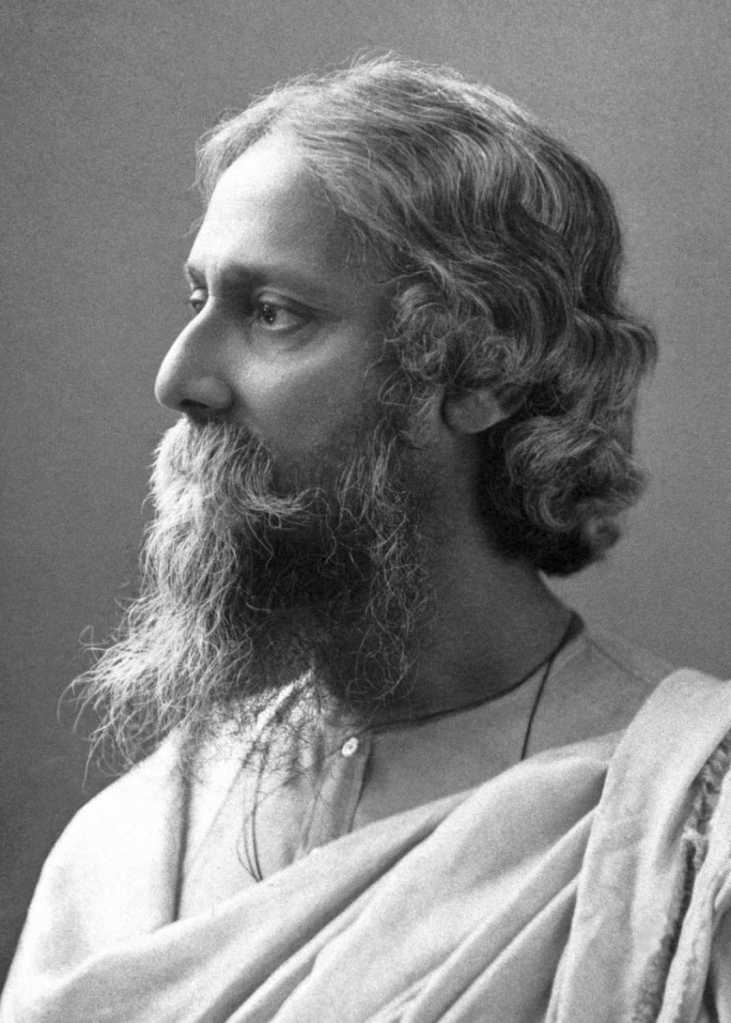
Rabindranath Tagore in 1909. Av Generalstabens litografiska anstalt – Various, e.g. [1], published in 1914 in Sweden in Les Prix Nobel 1913, p. 60.
Although often associated with anti-colonial movements, Tagore occupied a somewhat ambivalent position within the political debates of his time. He was deeply critical of British imperial rule and consistently defended the cultural and intellectual autonomy of colonized peoples. At the same time, he remained sceptical of forms of nationalism that merely mirrored the exclusionary and hierarchical structures of empire. For Tagore, liberation could not simply mean replacing one dominant system with another. Rather, it required reimagining humanity’s relationships to knowledge, culture, creativity, and one another.
These concerns are especially visible in his 1917 lecture What is Art?, the very text that Savio chose to transcribe in its entirety.
In the lecture, Tagore argues that art should not primarily be understood as the representation of objects. He suggests, on the contrary, that art is the expression of what he terms human personality. Art emerges from the desire to communicate experiences, feelings, and modes of being that exceed purely practical concerns. Through artistic creation, individuals and communities reveal something of themselves to the world, while at the same time also participating in a wider human conversation. Art, in other words, becomes a means of making relationships visible.
Reading these reflections today, it is difficult not to wonder what a Sámi artist living under the pressures of Norwegianization might have recognized in Tagore’s words.
Across Colonial Worlds
It would be tempting to frame a possible relationship between Savio and Tagore simply as a story of influence. Yet I am not convinced that this is the most productive approach.
The notebook does not allow us to determine precisely what Savio thought about Tagore, nor does it provide direct evidence that he adopted Tagore’s philosophical positions wholesale. What it does reveal is an encounter, and encounters often tell us as much about affinity as they do about influence.
Despite the considerable distance separating India and Sápmi, both Tagore and Savio inhabited worlds profoundly shaped by colonialism. Both witnessed attempts to marginalize languages, suppress cultural practices, and redefine relationships to land, knowledge, and belonging. Both also turned to artistic practice as a means of articulating alternative possibilities.
The similarities should not be overstated. Their historical circumstances were, after all, different, as were their political contexts and cultural traditions. Yet what I find particularly compelling is the extent to which both seem concerned with a common set of questions.
How does cultural knowledge survive under colonial conditions?
How do communities maintain continuity in the face of assimilation?
What role can art play in sustaining relationships between people, place, memory, and future generations?
And perhaps most importantly: how might creativity itself become a form of resistance?
These are precisely the kinds of questions that emerge repeatedly throughout Savio’s work and archives.
Toward a Trans-Indigenous Intellectual Geography
The discovery of Tagore’s lecture consequently invites us to reconsider the intellectual worlds through which Savio moved.
For much of the twentieth century, Sámi art has largely been discussed within Nordic frameworks. While such approaches remain valuable, they also risk obscuring broader networks of exchange, influence, and affinity that connected Indigenous and colonized peoples across the globe.
In my view, the Tagore notebook offers a glimpse into one such network. Here, I don’t necessarily mean a formal network comprised of organizations, manifestos, or coordinated political movements, but rather an intellectual geography shaped by shared experiences of colonial domination and by common concerns regarding cultural continuity, self-representation, and creative freedom.
Viewed from this perspective, Savio appears not simply as a Sámi artist responding to conditions in Norway, but as an intellectual whose horizons may have extended far beyond the Nordic region. The presence of Tagore in his notebook suggests that he was engaging with ideas emerging from other colonized worlds and considering how such ideas might speak to his own circumstances.
What we are left with, then, is a vision of Savio that is simultaneously local and global. Deeply grounded in Sámi lifeworlds, certainly, but never isolated from wider conversations concerning colonialism, culture, and modernity.
Indeed, one might even argue that the notebook reveals a form of trans-Indigenous or anti-colonial intellectual kinship, connecting Sápmi to broader struggles for cultural survival and self-determination taking place across the twentieth century and at a much earlier stage than has previously been assumed.
Returning to Hásttuheaddjin
This brings us back to hásttuheaddjin.
If the concept describes someone who resists while simultaneously encouraging alternative possibilities, then Tagore’s presence in Savio’s archive begins to make a certain sense.
For both figures, artistic practice was never solely about aesthetics. Art carried ethical responsibilities. It sustained relationships. It nurtured cultural memory. It provided a means through which people could remain present within systems that sought, in different ways, to render them absent.
In this regard, Savio’s art can be understood as a profoundly hásttuheaddjin practice.
His images do not merely document Sámi life. They insist upon its continued existence, challenging colonial narratives of disappearance while simultaneously making space for Sámi futures. Through land, animals, livelihoods, movement, and everyday life, his works affirm relationships that colonial systems repeatedly attempted to fracture.
Seen in this light, the handwritten copy of What is Art? becomes more than an archival curiosity. I would go as far as to argue that it becomes a trace of an unfinished conversation between two artists working from different colonial worlds yet grappling with remarkably similar concerns.
Whether Savio ultimately agreed with Tagore in every respect is impossible to know.
What we can know, however, is that he deemed the lecture important enough to copy, line by line, into one of his notebooks.
For me, that gesture remains significant, and not because it somehow provides a definitive answer to who John Savio was, as if that is even necessary. But it does remind us that the artist who emerges from the archive is invariably more complex, more connected, and more intellectually expansive than the one I, at least, thought I knew.
A small note of clarification: The transcribed lecture was previously on print in Niels Christian Bang’s John Andreas Savio – grafikk, slekt og biografi. There was, however, no reference made to Tagore himself and the transcription was printed simply as text from John Savio’s notebook. THe Savio-Museum as well was not familiar with the relation to Tagore.
References
Bang, N. C. (2022). John Andreas Savio: Grafikk, slekt og biografi. Bokstav og Bilde.
Coulthard, G. S. (2014). Red Skin, White Masks: Rejecting the Colonial Politics of Recognition. University of Minnesota Press.
Finbog, L. R. (2023). It Speaks to You: Making Kin of People, Duodji, and Stories in Sámi Museums. Dio Press.
Finbog, L. R. (2026). Hásttuheaddjin: The Voice of Resistance. Exhibition essay manuscript.
Hansen, H. H. (2010). “Decolonising Sámi Art History.” In Making Histories: Nordic Art and Visual Culture. Oslo: Novus Forlag.
Pushaw, B. (2021). “Blackness at the Edge of the World: Making Race in the Colonial Arctic.” Periskop – Forum for kunsthistorisk debat, 25, 60-75.
Simpson, L. B. (2017). As We Have Always Done: Indigenous Freedom Through Radical Resistance. University of Minnesota Press.
Rabindranath. Nationalism. New York: Macmillan, 1917.
Rabindranath. “What is Art?” Lecture delivered 1917, later published in Personality.
Tuck, E., & Yang, K. W. (2012). “Decolonization Is Not a Metaphor.” Decolonization: Indigeneity, Education & Society, 1(1), 1-40.
Wolfe, P. (2006). “Settler Colonialism and the Elimination of the Native.” Journal of Genocide Research, 8(4), 387-409.

